
DPM Barcode Scanning for a Data Center Hyperscaler
Case Study Summary
Data centers need to maintain rigorous hardware maintenance practices to ensure maximum uptime. By tracking thousands of individual components, organizations can predict equipment failure and take action before that failure occurs. Data organization is vital to this process, and barcode scanners help maintain that data integrity.
Standard barcode scanners aren’t always up to the task. In this case study, learn how a data center hyperscaler worked with Brady and Levato to develop a custom solution that guarantees reliability and performance.
Complex Barcode Scanning at Scale
Modern data center infrastructure requires rigorous asset management to facilitate predictive maintenance. Through precise indexing, technicians can replace components during scheduled maintenance windows, avoiding unexpected outages and lost revenue. Barcode scanners automate this data collection, allowing administrators to monitor thousands of components across their hardware lifecycles. When a part is decommissioned, both the old and replacement components must be scanned and logged in the inventory system.
The primary obstacle in this workflow centers on how components are marked. Many parts lack affixed labels and instead use Direct Part Marking (DPM), requiring hardware to read codes etched into varying, sometimes curved, surfaces. Standard barcode scanners frequently fail in these environments. Because of the fast-paced nature of data center operations, technicians need first-time read accuracy to maintain efficiency.
The Strategy
When standard barcode scanners failed to perform, the hyperscaler reached out to Levata, a global technology solutions provider specializing in data capture and hardware integration.
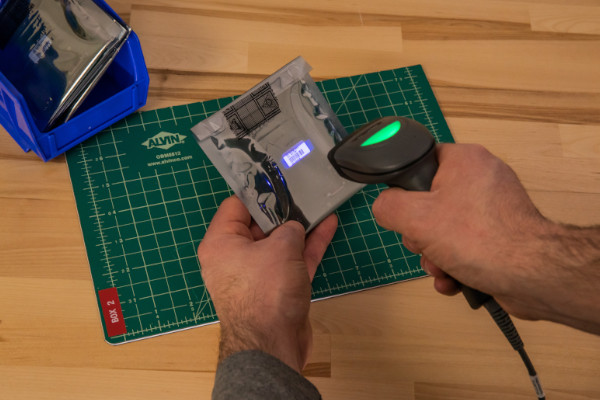
Levata works with hundreds of companies and equipment manufacturers to find custom solutions for complex problems. Leveraging extensive experience in challenging scanning environments, Levata partnered with Brady to deploy the CR1500 Handheld Barcode Scanner equipped with a specialized DPM scan engine.
The CR1500 is widely utilized in the healthcare industry, where scanning environments mirror the strict requirements of data centers. In medical settings, devices are frequently direct-marked, and curved surfaces like test tubes require high-accuracy decoding under tight time constraints.
The CR1500 addressed three core requirements:
- Form Factor: The compact, ergonomic design allows technicians to maneuver easily within tightly packed server racks.
- Advanced Decoding: The specialized DPM engine provides the precision necessary to reliably decode etched, low-contrast and curved barcodes.
- Programmability: When there were lighting issues that affected scan reliability, our team worked directly with them to fine-tune the scanner to work the first time, every time.
Implementation and Ongoing Partnership
We’ve partnered with Levata for years to provide scanning solutions for different customers across industries, but we started customizing the CR1500 for this hyperscaler four years ago.
Focusing on long-term operational viability and software compatibility, we knew that an ongoing partnership was key to implementing a successful solution and adapting to challenging conditions. A significant part of that.
While low-light conditions and variable materials can cause frequent read failures, our team wrote custom programmable code that runs in conjunction with proprietary software to adjust the scanning settings for low-light accuracy. And our ongoing relationship means we’re there to help troubleshoot any issues that arise.
Work with Brady
The tailored configuration of the CR1500 scanners successfully normalized data collection across all facilities. This data standardization allows maintenance schedules to be monitored both at the facility and at corporate headquarters, leading to efficient equipment changeovers and reduced downtime.
Have a complex problem with barcode scanning? Work with Brady to develop a custom solution.